
Dentistry Assignment Help UK: BDS Essays, Case Work and Clinical Reflection, Written Properly
Quick answer: If you need a clear model answer for a dentistry assignment, United Academic Help produces fully referenced examples — from £20 per 1,000 words at standard undergraduate level and deadline. The models cover BDS essays, case-based work, treatment planning, and reflective writing across restorative dentistry, periodontology, oral surgery, orthodontics, paediatric dentistry and oral medicine. Each one is written in the language of UK dental education: diagnosis first, evidence weighed, options compared, and decisions justified in terms of the individual patient rather than by textbook generalities.
Dentistry assignments are unlike general science essays because every academic claim sits next to a clinical decision. A student who can describe periodontal disease may still lose marks for a treatment plan that ignores the patient’s medical history, smoking status or plaque control, or for a case discussion that recommends a technically elegant option the patient could not maintain. Markers look for that integration: basic science applied, guidelines understood, risks balanced, and the patient’s circumstances kept in view throughout. A model answer on your exact title shows how that integration looks on the page — the relevant science stated briefly, the clinical reasoning made explicit, and the conclusion tied to the case in front of you rather than to dentistry in general.
The work we cover
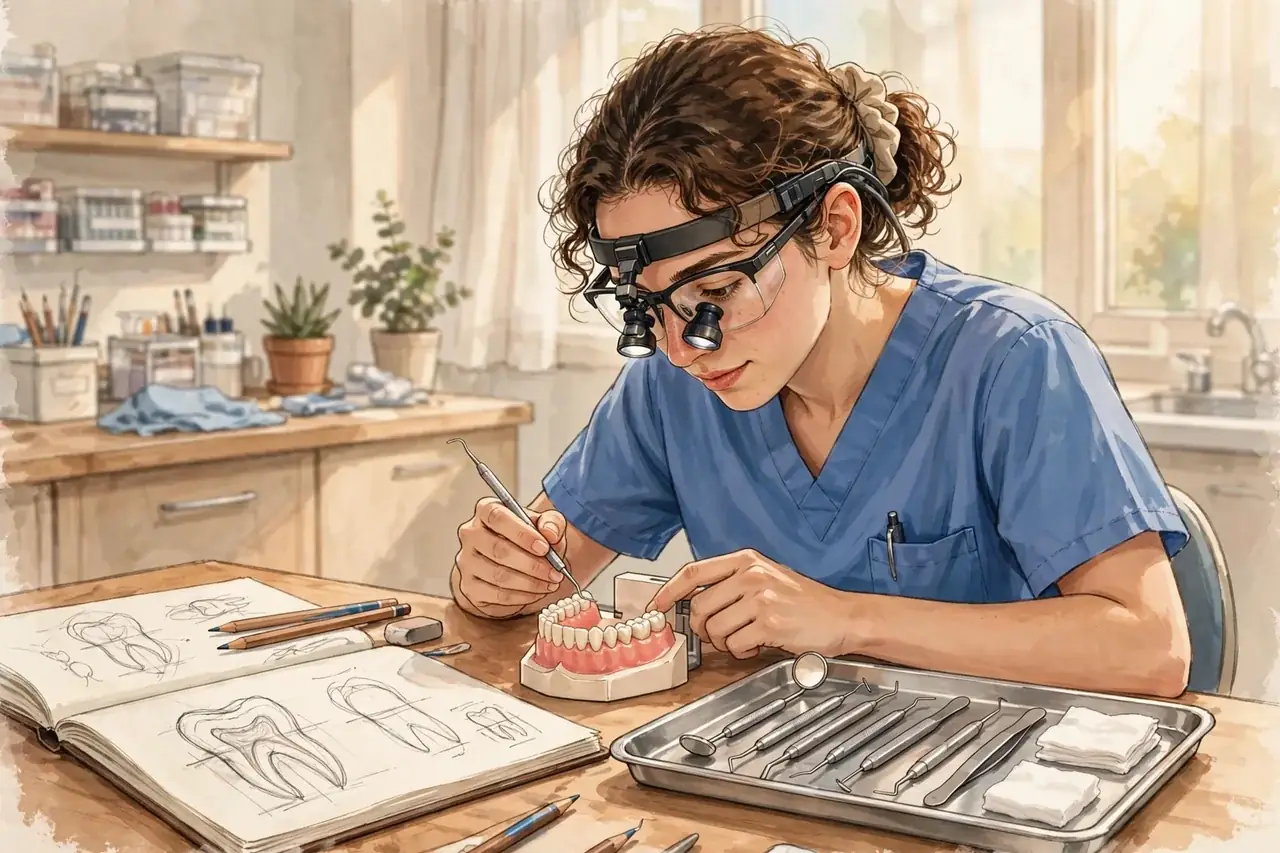
Restorative dentistry and cariology
Restorative assignments test diagnosis, material choice and long-term thinking together. Models cover caries diagnosis and risk assessment, prevention and minimally invasive management, direct and indirect restorations, endodontics, and fixed and removable prosthodontics, with each decision justified from the case details. A caries question is answered through risk factors, lesion activity and the balance between prevention, remineralisation and operative intervention, not through a list of materials. An endodontic case discussion addresses diagnosis, pulp vitality testing, working-length determination, obturation principles and prognosis, including the factors that make retreatment or extraction the more honest option. Material choices are compared on properties that matter for the specific tooth and patient — strength, wear, aesthetics, moisture sensitivity and repairability — rather than by brand preference.
Periodontology, oral surgery and oral medicine
These areas reward systematic assessment. Periodontology models cover diagnosis and classification, risk-factor management, non-surgical therapy, surgical options and maintenance, with plaque, smoking, diabetes and occlusion considered as interacting factors rather than isolated bullet points. Oral surgery models address exodontia, impacted teeth, medical complications, consent and post-operative care, with attention to when referral is the correct decision rather than a sign of weakness. Oral medicine work covers ulceration, white and red lesions, salivary gland disorders and the oral manifestations of systemic disease, where the skill is differential diagnosis: what fits, what does not, what investigation would discriminate between the remaining options, and what must not be missed. Red-flag features are named explicitly, because a marker needs to see that a student knows when urgency matters.
Orthodontics, paediatric dentistry and special care
Orthodontic assignments combine assessment, growth and patient factors. Models cover malocclusion classification, space analysis, treatment timing, appliance selection, and retention, with the distinction kept clear between what orthodontics can change, what growth will change, and what neither can fix. Paediatric models address caries management in children, behaviour management, trauma, and safeguarding awareness, with communication and consent handled as clinical skills rather than as afterthoughts. Special care dentistry work addresses patients with medical, physical, sensory or intellectual needs, where the treatment plan must adapt — shorter appointments, modified positioning, medical liaison, and capacity and best-interests considerations — without lowering the standard of care. Across all three areas, the model keeps the patient’s age, cooperation and long-term interests at the centre of the plan.
Case-based work, treatment planning and reflection
Case work is where dentistry marking is most demanding, because a plan must be complete, sequenced and defensible. Models present a case in a logical order — presenting complaint, history, examination, special investigations, diagnosis, and a phased plan covering urgent care, disease control, definitive treatment and maintenance — with each phase justified and alternatives considered. Reflection is handled as structured clinical thinking, not as a diary: what happened, what the evidence and guidelines suggest, what could have gone differently, and what will change in future practice. Referencing follows Vancouver style where a department requires it, with numbered citations and a reference list that can be checked, and guidelines from bodies such as the Faculty of General Dental Practice and the British Society of Periodontology are cited where they bear on the decision. Our Vancouver referencing generator builds those numbered entries and the reference list for you, in the order your sources are cited.
Inside the topics markers set most often
Some dentistry questions recur because they test judgement under uncertainty. The management of a heavily restored tooth is one: the answer must weigh restoration, crown, endodontics, extraction and implant options together, considering tooth prognosis, patient preference, cost and maintenance rather than recommending the most advanced option by default. Periodontal prognosis is another, where a tooth-by-tooth assessment beats a whole-mouth generalisation, and where furcation involvement, mobility and patient compliance change the plan more than pocket depth alone. In oral medicine, the recurring test is the lesion that does not fit neatly: the answer must generate a differential, prioritise by danger as well as likelihood, and specify the investigation or referral that resolves the uncertainty. In paediatric dentistry, trauma questions reward a calm sequence — history, examination, radiographs, splinting or monitoring decisions, and follow-up — with the child’s cooperation and the developing dentition kept in view.
Where dentistry marks are actually lost
Dentistry feedback follows a recognisable pattern. Textbook answers to case questions come first: a general account of a disease is submitted where the question asked for a plan for this patient, so the case details go unused. Missing justification comes next, where an option is chosen without saying why alternatives were rejected, leaving the marker unable to credit clinical reasoning. Guidelines ignored or misapplied lose marks too, when a recommendation is quoted without the patient factors that would modify it, or when an outdated approach is presented as current practice. Reflection without analysis weakens reflective work, where feelings are described but no evidence, guideline or alternative action is brought into the discussion. Finally, sloppy referencing undermines otherwise good work in a subject where Vancouver numbering must match the list exactly. Our models avoid each fault by planning for the named patient, justifying every choice against its alternatives, applying guidelines to the case, analysing reflection with evidence, and referencing carefully.
How it works
- Send the case or question with its clinical details — include the title, level, word limit and deadline, plus any case history, radiograph descriptions, charts or guidelines your department specified.
- Agree a fixed price and delivery date up front, in writing — calculated from the published rates for your level and turnaround, with nothing added later.
- A dentistry specialist drafts the model for your case — diagnosis reasoned, options compared, plan sequenced, reflection structured, and sources cited in Vancouver style where required.
- Review it against your teaching and ask for changes — question any clinical choice, and request a revision if any part of the brief or case detail was missed.
Writing a treatment plan a marker can trust
A treatment plan earns trust through sequence and honesty. Start with the urgent: pain, swelling, trauma or any feature that cannot wait, and say what will be done at the first visit. Then address disease control, because definitive work placed in an uncontrolled mouth is likely to fail: oral hygiene, diet, smoking, caries stabilisation and periodontal therapy come before crowns and implants. Only then set out definitive treatment, tooth by tooth, with the reasoning for each choice and the alternative that was considered and set aside. Include maintenance and review, because a plan without recall, radiographic monitoring and prevention is incomplete. Throughout, note where patient preference, medical history or cost changes the ideal plan, and say what would trigger referral. A model written this way reads like a clinician thinking, not a student listing treatments, and that difference is where case-work marks are found.
Consent and communication run through every dentistry assignment, even when the question appears to be purely technical. A plan that a patient has not understood or accepted is not a plan at all, so the model should show how options were explained in terms the patient could weigh: benefits, risks, alternatives, costs, maintenance burden and what happens if nothing is done. For anxious patients, children, or patients with additional needs, the approach to communication itself becomes part of the clinical reasoning — shorter explanations, visual aids, written summaries, or a parent or carer involved with appropriate consent. Documentation matters here too: what was discussed, what the patient decided, and what warnings were given should be recorded as carefully as any clinical finding, because that record protects both patient and clinician if the outcome is later questioned. A case answer that treats consent as a signature at the end of a plan misses the point; consent is the process by which the plan becomes legitimate, and markers in dentistry expect to see it handled that way.
Follow-up completes the picture a case answer should leave. State when the patient will be reviewed, what will be re-examined at that visit, and which signs would bring the review forward, such as persistent pain, swelling, or a restoration that no longer seals the tooth. That closing detail shows the plan was written for a real patient over time, not for a single appointment.
Dentistry assignment questions
Can you help with a case I have seen on clinic?
Yes. Send the case details, anonymised as your department requires, along with examination findings and any investigations. The model will be built around that patient, with the plan justified from the findings rather than from a generic textbook case. Patient confidentiality must be protected: never include names or identifying details.
Do you cover all BDS years, from basic science to finals?
Yes. Early-year work on anatomy, physiology, dental materials and disease mechanisms is covered, as are later clinical essays, case presentations and finals-style treatment planning. Tell us the year and module and the model will be pitched at that stage of training.
What referencing style do dentistry departments use?
Most UK dental schools use Vancouver, with numbered in-text citations and a reference list in citation order. Send your department’s guide and the model will follow it, including correct journal abbreviations and citation numbering that matches the list.
Can a model help with reflective writing for my portfolio?
Yes. Reflective models use a recognised structure, connect the experience to evidence and guidelines, and end with a concrete change in future practice. The reflection stays honest about uncertainty and mistakes, because a reflection that only reports success teaches nothing and convinces no marker.
Do you cover orthodontics and paediatric dentistry?
Yes. Both are covered in full, including assessment, treatment timing, behaviour management, trauma and safeguarding awareness, with the patient’s age and cooperation treated as central planning factors rather than footnotes.
I have a deadline very soon. Can a dentistry model still be produced?
Often, yes, for shorter essays and case discussions where the case details are already available. Send the exact title and deadline immediately, and you will be told plainly what can be done well in the time available.
Get dentistry assignment help today
Send your question or case, level and deadline for a free, no-obligation quote, and include any case details or guidelines the model must follow.
Message us on WhatsApp for your free quote · Or email team@unitedacademichelp.uk
Working across healthcare subjects? Students often pair this page with our pharmacy assignment help for medicines, prescribing and patient-safety overlap and our nursing assignment help for care planning and patient-centred practice.