
Animation Assignment Help UK
Animation degrees ask students to be storytellers, technicians, and critics at the same time, and the written work is where many strong animators lose marks. The shot may move beautifully, yet the production journal, storyboard rationale, or theory essay that explains it can read as vague, under-evidenced, or disconnected from the animation itself. Tutors do not mark movement alone; they mark how convincingly the choices behind that movement are justified, how carefully the work responds to the brief, and how honestly it deals with what did not work and what changed as a result.
United Academic Help produces fully referenced model answers for animation students across the United Kingdom, written against the individual brief rather than a generic template. Each model is supplied as a study aid: a worked example showing how an expert structures a production argument, documents a pipeline, and writes critically about animation, so you can see what good looks like before writing your own submission. Prices start from £20 per 1,000 words for written models, and they cover 2D and 3D animation, stop motion, motion graphics, storyboarding, and animation history and theory, at undergraduate and postgraduate level.
The work we cover
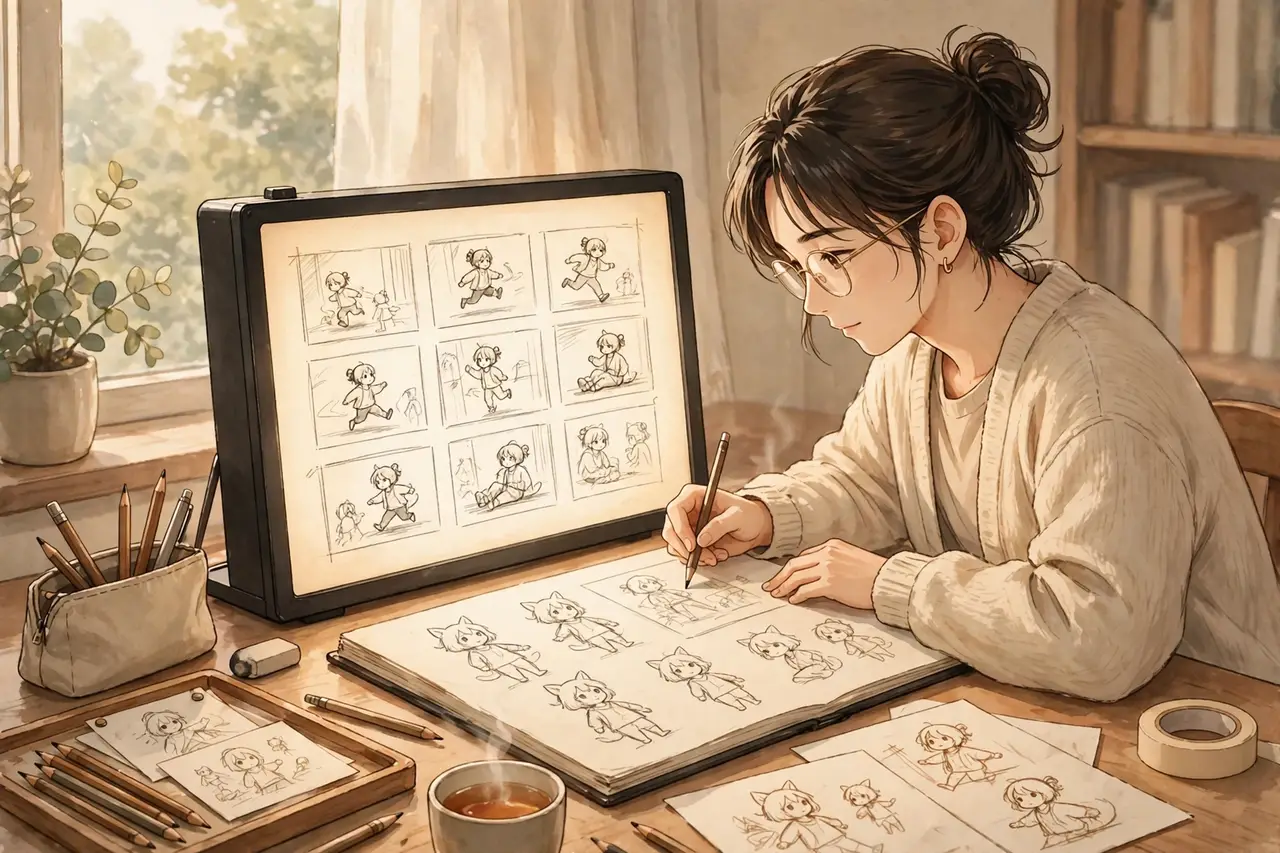
Animation coursework takes several distinct forms, and each one is judged differently. A storyboard or animatic rationale must explain narrative, staging, camera, timing, and continuity as deliberate decisions, not as accidents of drawing. A production journal or log must show iteration over time, with dated reflection on tests, feedback, and technical problems. A technical report must name software, tools, settings, and pipeline stages accurately enough for a specialist marker to follow. A theory or history essay must argue from sources, and a reflective evaluation must connect the finished film to the original brief and to what was learned.
Referencing in animation follows your department’s guide, most commonly Harvard, and visual and film sources need the same care as text. Films, series, shorts, and practitioner work are cited in a form a tutor can verify, and stills or frames used in an appendix need captions that state what they show and where they came from. A strong model never invents a precedent, a production step, or a software capability; it cites what it actually used and is clear about the limits of what a source or a test can support.
Story, storyboarding and pre-production
Pre-production writing is where an animation’s argument is first made, and markers read it as evidence of directorial thinking. A model storyboard rationale explains the story in terms of character want, obstacle, and change, then shows how each shot serves that story: why this framing, why this camera move, why this cut, and how long the shot needs to last. It discusses staging, silhouette, eye direction, and continuity, and it explains what was left out as well as what was kept, because a board that tries to show everything usually communicates nothing clearly.
Animatics, beat boards, and shot lists receive the same treatment. A model explains timing decisions in seconds and frames where the brief requires it, relates pacing to emotion and narrative beat, and shows how sound, even at rough stage, shapes the reading of a shot. Character and environment design writing follows the same pattern: it justifies design choices against story, audience, and production feasibility, and it shows development — alternative designs considered, feedback received, and reasons for the final choice — rather than presenting a finished design as though it arrived fully formed.
The twelve principles, movement and performance
Movement writing fails most often through vagueness: a shot described as smooth, expressive, or dynamic without saying what, in timing, spacing, or posing, makes it so. A model answer in this area is specific. It uses the twelve principles — squash and stretch, anticipation, staging, timing, exaggeration, and the rest — as analytical tools, not as a checklist to be ticked, and it explains each choice in relation to weight, intention, and character. A walk cycle, a jump, a lift, or an acting shot is broken down into blocking, breakdowns, and polish, with reasons given for each stage.
Performance and acting work needs particular care. A model distinguishes between a movement that is technically clean and a performance that communicates intention, and it explains how reference, observation, and iteration shaped the result. Lip sync, facial performance, and body mechanics are discussed with attention to phonemes, emphasis, and subtext where relevant, and the model is honest about where a performance is limited by rig, time, or skill, and what a further pass would address. That honesty is what turns a technical description into critical reflection.
2D, 3D and stop-motion pipelines
Pipeline writing tests whether a student understands a production as a sequence of dependent stages, each with its own decisions and risks. A model 2D report follows the work from rough keys through clean-up, colour, compositing, and sound, explaining what each stage adds and what errors it can introduce if rushed. A 3D report follows modelling, rigging, layout, animation, lighting, rendering, and compositing in the same way, naming software and settings accurately — Maya, Blender, TVPaint, After Effects, or the tools your course actually uses — so a specialist marker can follow the workflow.
Stop motion brings its own disciplines, and a model treats them distinctly: armature and puppet construction, set building, lighting consistency, frame capture, and the handling of flicker, rig removal, and sound. In every pipeline, a good model discusses problem-solving as evidence: a rig that broke, a render that failed, a set that would not light evenly, and the workaround adopted, with its cost in time or quality stated plainly. That record of real production difficulty, handled professionally, earns far more credit than a pipeline described as though nothing ever went wrong.
Character, environment and visual development
Visual development writing must connect look to story, not merely admire a style. A model character-design rationale explains silhouette, proportion, colour, and expression in relation to character, audience, and readability in motion, and it shows how the design survives simplification for animation. Environment design is justified in the same way: layout, perspective, colour script, and lighting are discussed as storytelling tools that establish place, mood, and scale, and that support the action rather than competing with it.
Look development and lighting writing also need technical honesty. A model distinguishes between design intent, a test render, and a final output, and it explains material, texture, and lighting choices in terms of what the render actually shows. It does not claim a look that the supplied frames do not demonstrate, and it identifies where further work — a texture pass, a lighting revision, a colour grade — would improve the result. That measured self-assessment is exactly what evaluative marking criteria reward.
Sound, editing and post-production
Sound and editing are often treated as afterthoughts in student writing, and markers notice. A model post-production report explains sound design, music, dialogue, and mixing as narrative decisions: what the audience should attend to, what should sit beneath, and where silence does more work than sound. It discusses editing rhythm, transitions, and the relationship between cut and movement, and it explains how a sequence was assembled, revised, and finished for its intended screen, whether festival, online, or broadcast.
Technical post-production writing must be equally precise. A model names codecs, resolutions, frame rates, and delivery specifications where the brief requires them, and it distinguishes between a working file, a preview, and a final master. It reports render times, file management, and version control as part of professional practice, and it is candid about compromises forced by deadlines or hardware. A film delivered late, in the wrong format, or without sound design is a production failure, and a model that discusses those risks plainly reads as professional in a way that a purely aesthetic account never will.
Animation history, theory and critical writing
Animation history and theory essays require a student to argue, not merely to narrate or to praise a favourite film. A model essay organises material around a question — how a studio, a national tradition, or a technique responded to technology, politics, or commerce, or what a particular film actually does with movement, sound, and narrative — rather than marching through a chronology. It uses scholarly and primary sources together, distinguishes between a filmmaker’s stated intention and a critic’s later interpretation, and notes where consensus exists and where debate continues.
Critical writing about contemporary animation needs the same discipline. A model that discusses a series, a feature, or an independent short describes what is actually on screen — movement, staging, design, sound, and editing — before interpreting what it means, so the interpretation can be checked against the work described. It evaluates claims about innovation, influence, or audience with evidence, rather than repeating promotional language as though it were analysis, and it is careful about genre and cultural context, especially where a work comes from a tradition the writer is still learning.
Reflective journals, showreels and professional practice
Reflective writing in animation is an analysis of production decisions, not a diary of what happened. A model production journal uses a clear structure, keeps the focus on decisions rather than on feelings alone, and connects reflection to evidence such as test renders, crit notes, or audience feedback. It is candid about dead ends — a shot abandoned, a rig rebuilt, a story restructured late — because a dead end that taught something is worth more than a flawless narrative nobody believes, and because iteration is the substance of animation practice.
Professional practice writing, including showreel rationales, CV and portfolio commentary, and practice essays, tests a different skill: presenting work to people who may not be animators. A model in this area is clear, jargon-light where the audience requires it, and honest about roles in group work, individual contribution, credits, and next steps. It shows how an animator documents a brief, manages a schedule, responds to feedback, and presents options without overstating certainty — the habits tutors, and later employers, recognise as professional competence.
How your animation model takes shape
Begin by sending us your brief, your learning outcomes, and any boards, tests, films, or tutor feedback you already have. We read the brief against the marking criteria first, so the model is organised around what will actually be assessed rather than around a standard chapter order. If the brief asks for a storyboard rationale, a production journal, a technical report, or a theory essay, the structure follows that form, and the sources are chosen to fit the question instead of being gathered afterwards to fill gaps.
From there, the draft is built in a deliberate order: story and research first, then the argument that links decisions to evidence, then the technical and pipeline detail, and finally a check that every film reference is cited, every frame or still is captioned, and every claim can be traced to a source or a test. You receive a model you can study, question, and learn from — comparing its structure with your own draft, borrowing its approach to evidence and reasoning, and then writing your submission in your own words. If tutor feedback later points to a weakness, that feedback can be used to revise your own work with a clearer sense of what to change.
Starting your animation model
If a production deadline and a written deadline are colliding, or a journal is holding up an otherwise finished film, send the brief through and tell us where you are stuck. The most useful starting point is often a single paragraph describing the story, the shot, and the one decision you are least sure how to justify — that is usually where the strongest part of the model begins. We will shape a worked example around your actual film, not a substitute topic, so the reasoning you study transfers directly to the work you still have to write.
Animation assignment questions
Can you help with the written parts of an animation project?
Yes. Storyboard and animatic rationales, production journals, technical and pipeline reports, sound and editing commentary, theory essays, and reflective evaluations are all covered. The model is built around your brief and your film, so the writing supports the work you have made rather than inventing a different project.
Do you cover 2D, 3D, stop motion and motion graphics?
Yes. Hand-drawn and digital 2D, 3D character and environment animation, stop motion, and motion graphics are all covered, with pipeline stages, software, and the twelve principles discussed accurately for the form in question.
How are films, frames and visual sources referenced?
Films, series, and practitioner work are cited in your department’s style, with captions that make clear what each still or frame shows and where it came from. Sources that cannot be verified are not used, and claims about a technique or a production are kept within what the cited source actually supports.
Can you help with an animation dissertation?
Yes. Dissertation models cover topic framing, literature review, methodology for practice-based or audience-focused research, analysis, and discussion, with the same emphasis on traceable sources and a defensible argument throughout.
What if my film changed a lot during production?
Change during production is treated as evidence, not as a problem to hide. The model shows what changed, why, and what the change cost or gained, so the journal reads as genuine production reflection rather than a rewritten history.
Do you animate the film itself, or only the written work?
The model covers the written argument, rationale, and commentary around your project. Your animation remains your own studio work; the writing explains, justifies, and critiques it, so the two parts of your submission reinforce each other.
Is the model answer something I can submit as my own?
No. It is a study aid and worked example. Study how it structures the argument, documents a pipeline, and writes critically about movement, then write your own submission in your own words, in line with your university’s academic integrity policy.