
Question 5 is half of AQA GCSE English Language Paper 1: a single piece of creative writing worth 40 of the paper’s 80 marks, and as much as Questions 1 to 4 combined. It is also the question students most often reach tired, rushed and unplanned, because it sits last. That combination — maximum marks, minimum freshness — is why Q5 repays preparation more than any other part of the paper. This guide explains the choice you are offered, how the 40 marks divide, how to plan inside the exam, the structural and language moves that reach the top band, and the errors that quietly drain marks. It belongs with our GCSE coursework and NEA guide, which explains why English Language is an exam-only subject — there is no coursework safety net here, so the writing itself has to carry the grade.
A note on the help in this page. Q5 is written by you, alone, in the exam hall — nothing here can or should change that. What coaching can legitimately do is teach the craft beforehand: planning routines, structural control, sentence variety, and honest feedback on practice pieces you have written, so that the skill walks into the hall with you. That is the spirit of everything below, and it is also how timed writing improves fastest generally, as our guide to how to write a GCSE essay shows for the examined essay subjects.
The task: one choice, two kinds of writing
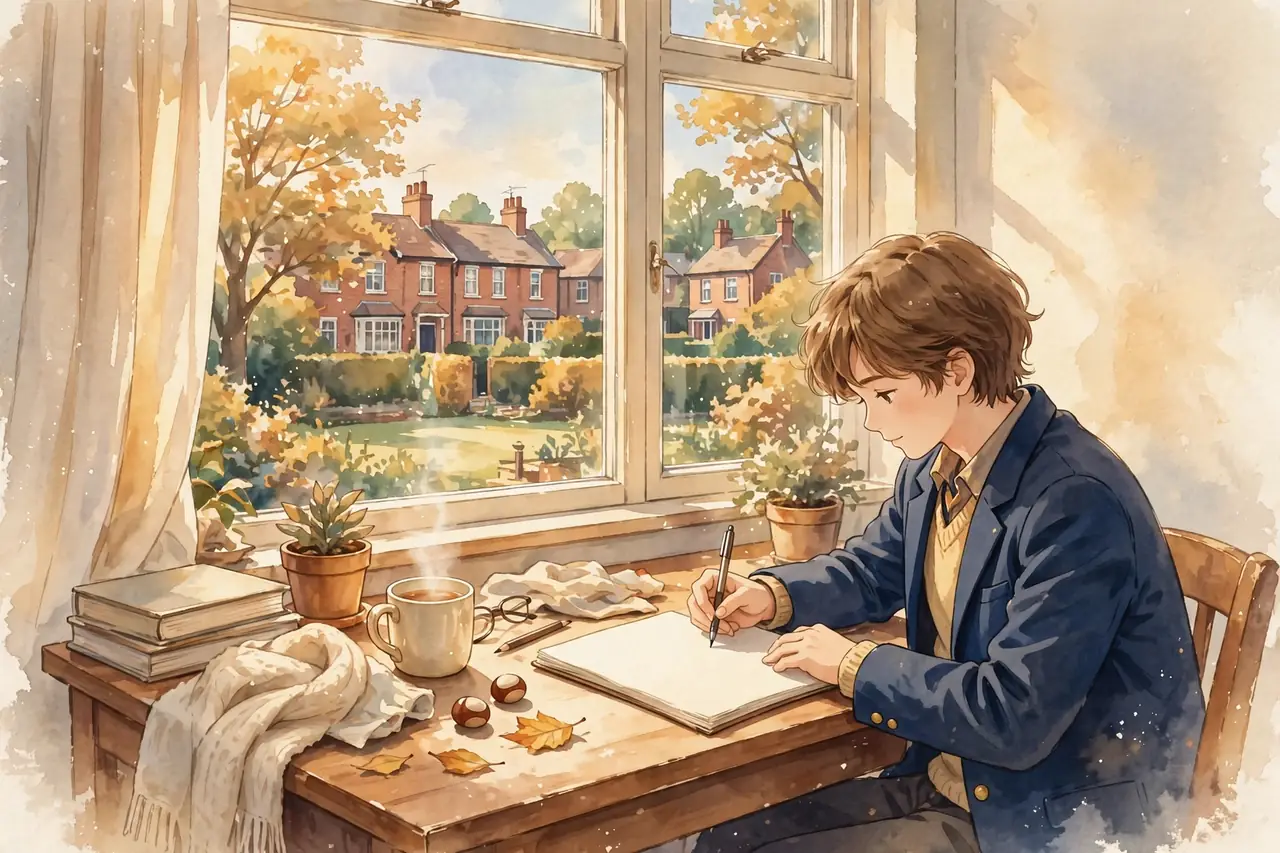
Paper 1 (Explorations in Creative Reading and Writing) lasts 1 hour 45 minutes. Section B contains only Question 5. You are offered a choice between two tasks and you answer one: a descriptive task, which comes with an image as its stimulus, or a narrative task built on a written prompt — a story theme such as an encounter, a discovery or a moment of danger. Both tasks are marked identically, so the choice is purely strategic: pick the form you have practised more, not the prompt that merely looks friendlier on the day.
AQA advises roughly 45 minutes for Section B, and the workable split inside that is about 5 minutes planning, 35 minutes writing and 5 minutes checking. In that time, most controlled, high-scoring responses run to around a side and a half to two sides — there is no set word count, and length beyond control earns nothing. What you are producing is not a novel chapter or a photographic inventory of the image. It is a short, shaped piece in which every paragraph has been placed.
Confirmed change for summer 2026: you write an opening, not a whole story
AQA announced changes to GCSE English Language (8700) in January 2025, for first examination in summer 2026, and its official summary of changes is explicit about Question 5 — this is a confirmed board change, not a rumour, though it changes the task’s framing rather than its marks: AQA states there are no changes to the assessment objectives or mark allocation. Two points matter. In the narrative question, students can write an opening of a story, rather than having to construct a full narrative. In the descriptive question, the prompt now states that you can use your imagination, with the image providing further ideas — a formal reminder that you were never required to catalogue the photograph. AQA has also added “typical features” columns to the mark scheme at each level for both kinds of writing, giving examiners and teachers a clearer picture of what responses at each level typically do.
Plan accordingly. If your exam is in summer 2026 or later, the narrative task explicitly invites an opening: establish a world, a voice and a tension, and stop while the story is still gathering — you no longer need to force an arc to a resolution inside 35 minutes, and openings were always where the marks for control lived. If you are practising with pre-2026 papers, the same advice produces strong answers there too, but check with your teacher which specification your entry follows and practise from your board’s current sample materials.
How the 40 marks divide: 24 for the writing, 16 for the accuracy
The split is fixed and worth memorising. Content and organisation (AO5) carries 24 marks: communicating clearly, effectively and imaginatively; adapting tone, style and register to the task; and organising the whole piece with structural control — paragraphing, sequencing and devices used for effect. Technical accuracy (AO6) carries 16 marks: sentence structures used with variety and control, a range of accurate punctuation, and spelling — including ambitious vocabulary spelled correctly.
Sixteen marks is a fifth of the paper, which makes the final five checking minutes the best-paid time in the exam. It also changes how to be ambitious: an unusual word spelled wrongly scores worse than a precise word spelled correctly, and a semicolon used wrongly is worse than the full stop it replaced. Ambition in Q5 means range you can control, deployed deliberately — not a technique sweepstake.
Planning in five minutes: small scope, chosen ending
A Q5 plan fits on a few lines and buys control over everything that follows. First, fix the scope: one setting, one moment or movement through it, and at most two characters — a 35-minute piece cannot carry more, and depth on one scene outscores tourism across five. Second, choose the mood and hold it: menace, wonder, decay, exhilaration. Third, sketch four to six paragraph beats in order — where the piece starts, what shifts, where it lands. Fourth, decide the ending image before you write the opening, because the strongest structural device available to you, cyclical return, requires the opening and ending to be planned as a pair. Fifth, note a short bank of precise vocabulary for your setting — verbs especially — so you are not inventing spellings mid-flow.
Worked example of the five-minute thinking, for a narrative opening on an abandoned fairground: setting (one dusk visit), mood (unease without cliché), beats (arrival and stillness → the carousel’s one movement → a sound that should not exist → approach → stop, mid-decision), closing image (the painted horse’s eye, echoing the first sentence’s “everything watched me”). That plan is six short lines. The writing can now spend its energy on sentences instead of decisions.
Structure that scores: devices with jobs to do
Examiners reward structure they can feel. Four devices earn their place repeatedly. Cyclical structure — ending where you began, with the image or phrase altered by what has happened — signals a shaped whole in a single move, and suits the opening-only narrative perfectly, since the return can be atmospheric rather than conclusive. Shifts of focus — the zoom from panorama to detail and back — give descriptive writing its architecture: establish the scene wide, descend to one object or figure and stay there long enough to matter, then lift away for the ending. A single-line paragraph, used once, lands like a held breath: it isolates a revelation, a sound, a decision. Used three times, it is merely short paragraphing. Flashback deserves a warning label: a brief, clearly signalled dip into memory can deepen an opening, but in 35 minutes it more often strands students in a second timeline they must then escape. If you use it, keep it to a few lines and return to the present with a deliberate echo.
Underneath the devices sits paragraph discipline: each paragraph changes one thing — place, time, mood, knowledge or tension. If a new paragraph changes nothing, merge it. If one paragraph changes three things, split it. That single rule produces the “increasingly sophisticated control” the top of AO5 describes, without any device-hunting at all.
Language and accuracy for the top band
Top-band writing is precise before it is decorated. Choose verbs that carry the image (“the mist clung”, “shutters rattled in sequence down the street”) over adjective stacks. Select sensory detail rather than listing it: two exact details — the smell of hot dust on a radiator, the tick of a cooling engine — outwrite a paragraph that works dutifully through all five senses. Vary sentence length on purpose: long, subordinated sentences to build atmosphere, then a short one to cut it. “The pier had been closed for eleven years.” A fragment, used sparingly and knowingly, is a legitimate effect at this level; a fragment caused by a lost main clause is an AO6 error, and examiners can tell the difference by whether the surrounding writing is controlled.
Punctuation range, accurately used, is the quiet AO6 earner: commas for listing and parenthesis, dashes for a single dramatic aside, a colon to deliver what a sentence has promised, a semicolon only if you are certain. Then protect the marks: in your checking minutes, read for the errors you personally make — your teacher’s feedback on practice pieces will have named them — and check ambitious spellings word by word. Five minutes of this is worth more than five more lines of plot.
An original worked opening, of the kind this planning produces: “The fairground exhaled when I pushed through the gate. Nothing moved — not the carousel horses, frozen mid-gallop with their painted eyes wide, not the bunting, which hung in the windless air like washing in a house where someone has died. Only the ticket booth ticked, cooling, as if the whole place had just that second stopped.” Note what it is doing: one setting, one mood, personification carried by a single verb, a short sentence (“Nothing moved”) doing structural work, and the watching-horses image planted ready for a cyclical ending.
The mark-losers examiners see every series
The recurring failures are predictable, which makes them avoidable. Plot sprawl: a whole life story — or, under the old habit, a full quest with rescue and resolution — compressed into breathless summary, with no scene ever allowed to develop. The image itemised: a descriptive response that walks the photograph left to right, listing contents, instead of using it as a springboard, which the 2026 wording now warns against in terms. Technique stuffing: a simile per sentence, each cancelling the last. Dialogue overload: pages of speech with no narration to control pace or tone. The unplanned ending: writing that stops because time stopped. And the silent killer, unchecked work: avoidable spelling and punctuation errors across 16 marks that a five-minute review would have halved. Every one of these is a planning failure before it is a writing failure — which is the good news, because planning is trainable.
Get coaching on your creative writing before the exam
If your practice pieces plateau — strong openings that dissolve, or accurate writing that never risks enough — that is a coaching problem with a coaching solution. We work on practice tasks you write under timed conditions, give feedback keyed to the AO5 and AO6 strands so you can see which marks you are dropping, and build your planning routine and checking habits until they hold at exam pace. Model material is supplied to study for the standard, never to memorise and reproduce — examiners reward writing that is plainly the candidate’s own. Support is priced from £20 per 1,000 words of material reviewed or prepared. Send your brief — exam series, current grade and target — place an order through the site, email team@unitedacademichelp.uk, or reach us on WhatsApp via the contact page.
Frequently asked questions
How many marks is Question 5 worth, and how are they split? 40 marks — half of Paper 1. Content and organisation (AO5) carries 24 marks; technical accuracy (AO6) carries 16, covering sentence variety, punctuation range and spelling. AQA confirms the 2026 changes leave this allocation untouched.
Do I have to write a complete story for the narrative task? For exams from summer 2026, no: AQA’s confirmed change means the narrative task asks for an opening of a story rather than a full narrative. Establish character, setting and tension, and end with control. If your entry follows an earlier specification, confirm the wording with your teacher.
How long should I spend on Question 5? Around 45 minutes in total, as AQA advises for Section B: roughly 5 minutes planning, 35 minutes writing and 5 minutes checking. Protect the checking minutes — they defend 16 accuracy marks.
How much should I write? There is no set word count. In 35 minutes of controlled writing, most strong responses fill around a side and a half to two sides. A shorter, fully shaped piece outscores a longer, sprawling one.
Should I choose the description or the narrative? Whichever you have practised more. Both are marked against the same objectives and neither is inherently easier. The image is a springboard for the description — AQA’s 2026 wording stresses using your imagination — not an inventory to copy.
What is the quickest way to gain marks? Plan the ending before the opening so the piece can close cyclically, keep to one setting and mood, vary sentence length deliberately, and spend the final five minutes checking your known error patterns. Those four habits address both assessment objectives at once.