
An Objective Structured Clinical Examination, or OSCE, is unlike any written exam you will sit. There is no essay to plan, no question to interpret at leisure, and no chance to go back and improve an earlier answer. Instead, you move through a circuit of short stations, each lasting a few minutes, each testing one skill, and each marked against a checklist by an examiner who is watching you work. For nursing and medical students alike, OSCEs are the moment when knowledge has to become performance, under time pressure, in front of a stranger, with a simulated patient who may be anxious, confused, or deliberately difficult. That is a demanding test, but it is also a predictable one, and predictable tests can be prepared for systematically.
This guide explains how to prepare for an OSCE properly: how stations and mark schemes work, the frameworks that structure common station types, how to practise under timed conditions, the red flags that lose marks regardless of how much you know, and how to handle exam day itself. It is written for nursing and medical students in the UK, covering both kinds of OSCE, because the preparation principles are the same even where the clinical content differs.
How OSCEs work: stations, timing, and mark schemes
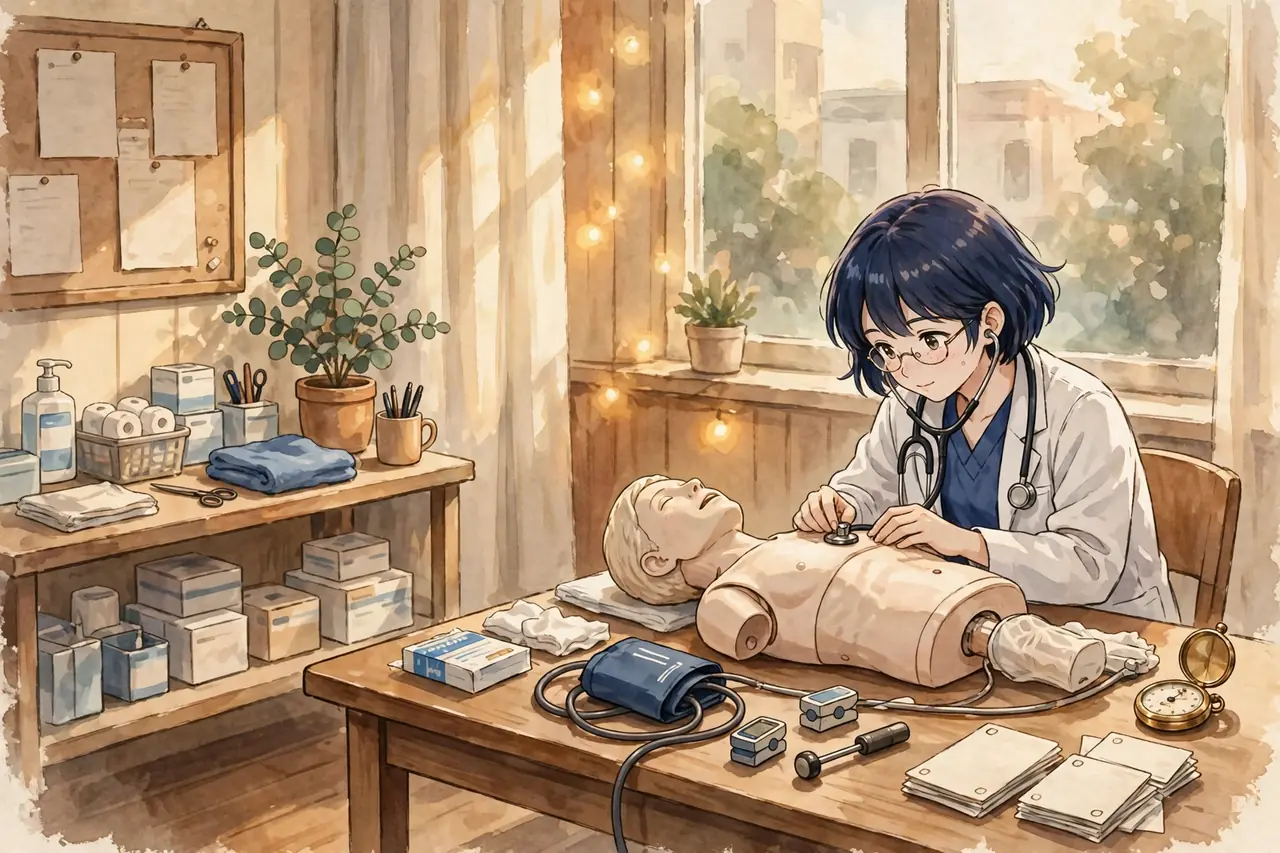
A typical OSCE circuit contains between 10 and 20 stations, though the number varies by programme and year. Each station presents a task — take a history, examine a system, interpret a result, explain a procedure, demonstrate a practical skill — and gives you a fixed time, commonly five to ten minutes, with a bell or announcement marking the start and end. You read a brief outside the station, enter, perform the task, and move on. Some circuits include rest stations, where you simply wait, and some include written or data-interpretation stations with no patient present.
Marking is done against a structured checklist or a global rating scale, and usually both. The checklist awards marks for specific actions: introducing yourself, washing your hands, asking a particular question, performing a particular examination step, summarising the findings. The global rating captures the examiner’s overall judgement of your competence, communication, and safety. Understanding this matters for preparation, because it tells you that OSCE marks are earned by doing visible, specific things in the right order, not by demonstrating that you know a great deal in general. A student who knows the pathophysiology of heart failure but forgets to introduce themselves, check the patient’s identity, and gain consent has already lost marks before the clinical content begins.
Start with the station types, not with revision notes
Students often prepare for OSCEs by re-reading lecture notes. That is the least efficient way to prepare, because an OSCE does not test recall in the abstract; it tests performance of specific tasks. Start instead by listing the station types your programme uses, and prepare for each type separately. The common types are:
- History taking: a structured conversation with a simulated patient, covering presenting complaint, history of presenting complaint, past medical history, medication, allergies, social history, and systems review as appropriate.
- Clinical examination: a system examination, such as cardiovascular, respiratory, abdominal, or neurological, performed on a simulated patient or manikin.
- Practical procedures: a skill such as venepuncture, cannulation, catheterisation, wound care, or medicines administration, often on a model.
- Communication: breaking bad news, explaining a procedure or a diagnosis, handling an angry or distressed patient, or obtaining consent.
- Data interpretation: reading results such as blood tests, ECGs, or observation charts, and stating what you would do next.
- Prescribing and medicines: writing or checking a prescription, calculating a dose, or counselling a patient about a medicine.
Frameworks that carry you through stations
ABCDE: the approach to the acutely unwell patient
ABCDE — Airway, Breathing, Circulation, Disability, Exposure — is the framework for assessing and managing an acutely unwell patient, and it appears in OSCEs in many forms: a deteriorating patient station, a resuscitation scenario, or a station where the patient’s observations are abnormal and you must respond. The discipline of ABCDE is that you work in order and you treat life-threatening problems as you find them, rather than completing a full assessment before acting. State what you are doing as you go: “I am checking the airway, which is patent” tells the examiner you are following a system, even before you reach a conclusion. In an OSCE, a silent candidate is an unmarked candidate, because the examiner can only mark what they see and hear.
SOCRATES: structuring a pain history
SOCRATES is the mnemonic for taking a pain history: Site, Onset, Character, Radiation, Associated symptoms, Time course, Exacerbating and relieving factors, and Severity. It is worth learning precisely, because pain history stations are common and because a candidate who works through SOCRATES systematically will cover the ground a checklist rewards, while a candidate who asks about pain in general terms will miss items and lose marks. Practise it until it is automatic, so that under time pressure you do not have to think about what to ask next; you simply move to the next letter.
Other frameworks worth having ready
Timed practice: the only practice that counts
Practising a station without a timer is not OSCE practice; it is revision dressed up as practice. The defining feature of an OSCE is the time limit, and the most common reason capable students lose marks is not ignorance but running out of time: the history that never reached the summary, the examination that never reached the lower limbs, the procedure explained beautifully but never completed. Timed practice is how you learn the pace of a station, and it must be the core of your preparation.
Work in pairs or small groups wherever possible. One person plays the candidate, one plays the patient or examiner, and one observes with the checklist if you have one. Run the station to time, with the bell, and debrief immediately: what was missed, what was done out of order, where time was wasted, and what the candidate would change next time. Rotate roles, because playing the patient teaches you what a good candidate sounds like, and observing teaches you what an examiner notices. If you have access to past station briefs, past checklists, or your programme’s practice circuit, use them; if not, write your own briefs from the station types listed above and practise those.
Two habits make timed practice far more effective. First, practise your openings until they are automatic. The first thirty seconds of every station — introduce yourself, confirm the patient’s identity, wash your hands, explain what you are going to do, gain consent — should require no thought at all, because those marks are available in every station and they are the marks candidates lose when nerves take over. Second, practise closing a station cleanly. Summarise your findings, state your impression and your next steps, thank the patient, and stop when the bell goes. A candidate who is still examining when time expires has not merely lost the closing marks; they have shown the examiner they cannot manage time, which colours the global rating.
Red flags: the mistakes that fail stations on their own
The most common red flags include: failing to check the patient’s identity or allergies before giving a medicine; failing to wash hands or maintain infection control; breaching patient dignity or consent, such as examining without permission or without a chaperone where one is required; failing to recognise a deteriorating patient or an abnormal result that requires urgent action; and documenting or prescribing something incorrectly, such as the wrong dose or the wrong patient. Some programmes also treat a failure to escalate appropriately — not calling for senior help when the situation requires it — as a red flag, because in real practice, knowing when to ask for help is a safety skill, not a weakness.
Communication: the marks hiding in plain sight
Communication marks are available in every station, including technical ones, and they are the easiest marks to gain and the easiest to lose. Examiners mark what they observe: did you introduce yourself, explain what you were doing in language the patient could understand, check understanding, show empathy when the patient was distressed, and maintain professional behaviour throughout? A candidate who performs a technically perfect examination in silence, without explaining a single step to the patient, will lose communication marks in a way that a candidate who narrates clearly will not.
Practise narration explicitly. Say what you are doing and why, in plain language, as you do it: “I am going to listen to your chest now. This may feel cold. Please breathe normally.” That sentence costs three seconds and earns marks for explanation, consent, and patient comfort. Avoid medical jargon with simulated patients unless you explain it, and avoid talking about the patient in the third person while they are present. Small courtesies — asking how the patient would like to be addressed, offering a tissue, checking comfort — are not window dressing; they are what the communication checklist measures.
Exam day: the practicalities that protect your performance
Exam day preparation is mostly about removing avoidable stress. Arrive early enough that a transport delay does not become a crisis. Wear the uniform or dress your programme requires, with hair tied back and nails short where clinical standards demand it, and bring any required identification and equipment. Eat and drink beforehand, because a circuit of stations is physically tiring and dehydration impairs concentration. Use the reading time outside each station properly: read the brief twice, identify the task, decide your framework, and note the first three things you will do. Do not spend reading time worrying about the previous station; it is gone, and the next station is a fresh set of marks.
Common mark-losing mistakes
Practising without a timer. Untimed practice teaches content but not pace, and pace is what the OSCE measures.
Skipping the basics. Introduction, identity check, hand hygiene, and consent are marks in every station, and they are the first marks lost to nerves.
Working in silence. The examiner can only mark what they see and hear. Narrate your actions and your thinking as you go.
Learning frameworks superficially. A half-remembered mnemonic slows you down without guiding you. Learn a few frameworks until they are automatic.
Ignoring safety. Red flag failures can fail a station outright, however strong the rest of your performance.
Revising notes instead of performing stations. Knowledge matters, but an OSCE tests performance. Spend most of your preparation time performing, not reading.
Frequently asked questions
How long is each OSCE station? Most stations last five to ten minutes, depending on the programme and the task. Check your programme’s information for the exact timing, and practise to that timing, not to a general guess.
Does failing one station mean failing the OSCE? Not usually. Most OSCEs use an overall pass mark across the circuit, so a weak station can be compensated by stronger ones, unless the failure was on safety grounds, which some programmes treat as an automatic station or overall failure.
Should I practise alone or in a group? Both have value, but group practice is more effective for OSCEs, because it reproduces the experience of performing in front of someone else and gives you feedback from an observer’s perspective.
What if I run out of time mid-station? Close as cleanly as you can: summarise what you found, state what you would do next, and thank the patient. A clear, incomplete station scores better than a station that collapses into silence.
Are nursing and medical OSCEs the same? The format is similar — timed stations, checklists, simulated patients — but the content, the skills tested, and the frameworks emphasised differ by profession. Prepare for the stations your own programme uses.
Closing guidance
OSCE preparation rewards structure over volume. Learn the station types, master a small set of frameworks until they are automatic, practise under timed conditions with other people, and build safety checks into every station as a habit rather than an afterthought. Do that consistently for several weeks, and the exam itself becomes a familiar routine rather than an unfamiliar ordeal. If you would like structured help preparing — timed practice plans, station frameworks, and model approaches to common station types — our OSCE exam help team can support you through it.