
Proofreading and Editing Service for UK Students: Your Words, Polished
Quick answer: We proofread and edit work you have written yourself — grammar, punctuation, sentence flow, referencing consistency and formatting — and return it clean, with the changes visible so you can see exactly what was corrected and why. Send your document on WhatsApp for an exact quote; editing is priced from £20 per 1,000 words on our published scale. What this service never does is rewrite your work into something you did not write: the ideas, the argument and the words remain yours, which is why proofreading sits comfortably inside every UK university’s rules on third-party editing.
Every year, students lose marks they already earned. The argument was sound, the evidence was there — but the marker waded through tangled sentences, drifting tenses, references in three different formats and headings that changed style every chapter, and the grade slipped a band. Proofreading is the cheapest marks recovery in higher education, because it fixes presentation without touching substance. It is also the one writing service with no integrity grey area at all: universities explicitly permit (and their study skills centres encourage) having your own work checked for language and presentation, provided the editor does not rewrite content. Our service is built exactly on that line, and it is one of the ways we have supported 1,000+ UK students — including many whose first language is not English and many native speakers who simply cannot see their own errors after the tenth read.
What our proofreading and editing includes
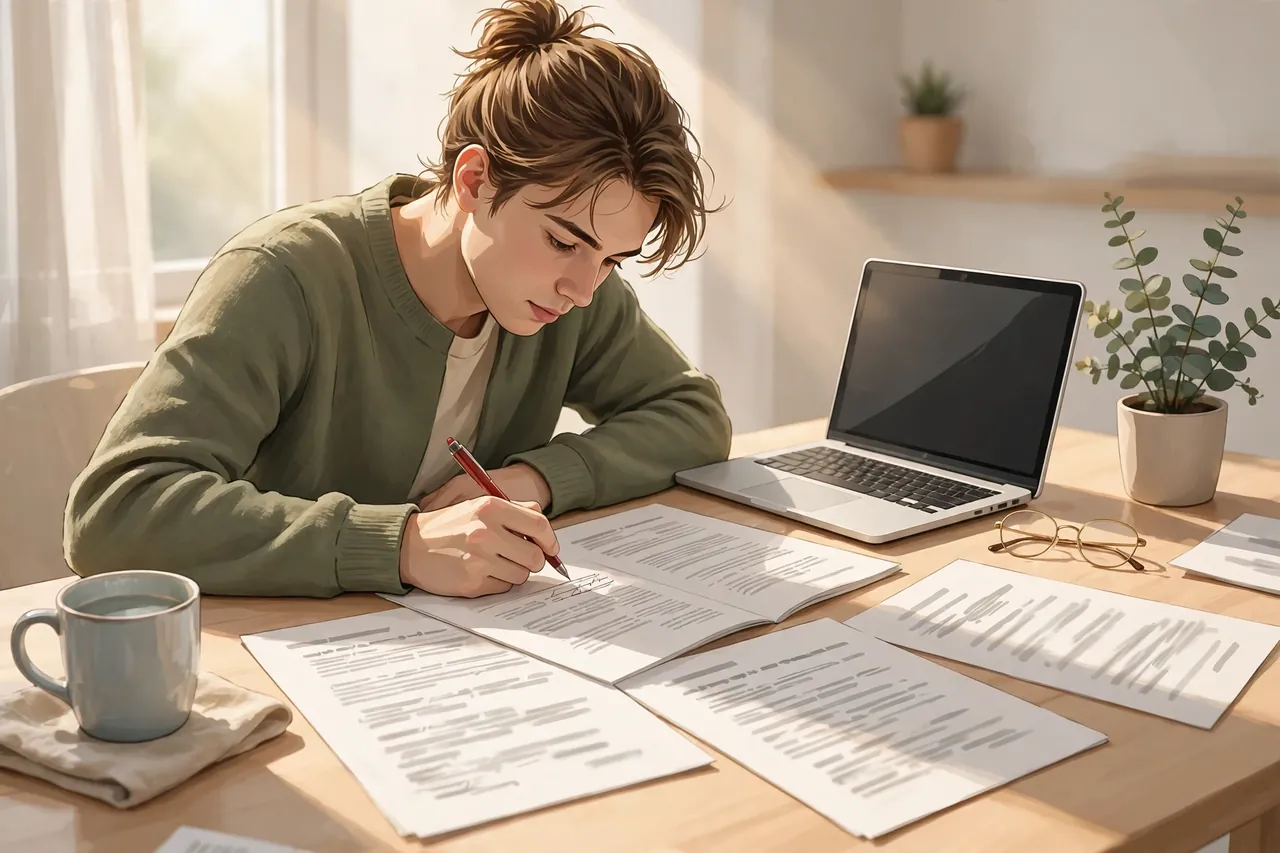
Language and mechanics
Grammar, punctuation, spelling (UK English throughout), capitalisation, article and preposition errors, subject–verb agreement, tense consistency, and sentence structure — fragments, run-ons and the 70-word sentences that bury a good point. Every correction is made with tracked changes on, so your returned document shows you each fix.
Flow and clarity editing
Beyond correctness: sentences reordered where the logic tangles, paragraph openings that actually signpost, repetition cut, transitions repaired, and academic tone steadied — hedging where a claim outruns its evidence, directness where a sentence hides behind padding. This is editing in the proper sense: your meaning, expressed at the standard your ideas deserve. Where a passage is unclear in substance — not just in language — we flag it with a comment rather than silently rewriting it, because the fix has to be yours.
Referencing checks
In-text citations matched against the reference list both ways (the orphan citation and the uncited list entry are the two commonest referencing errors in student work), then formatted consistently to your style: Harvard, APA 7, OSCOLA for law work, Vancouver for medicine and nursing, or your university’s house variant. Author names, dates, italics, punctuation and ordering — the details markers check first when they want to know if you are careful.
Formatting and presentation
Heading hierarchy, numbering, figure and table captions, contents pages, margins and spacing against your university’s presentation spec, and consistency of terminology, abbreviations and capitalisation across a long document — the unglamorous checks that matter most in dissertations, where a marker reads 15,000 words and inconsistency compounds.
What you receive back
Three things, every time. The clean copy: your document with all corrections accepted, formatted and ready to submit. The tracked copy: the same document with every change visible, so you can review, question or reverse any edit — nothing is ever changed invisibly. And a short editor’s note: the three or four error patterns that recurred most in your writing (articles, tense drift, comma splices, a referencing habit), each with a corrected example from your own text. That note is why students who use this service twice rarely need it a third time at the same intensity: the second document arrives with its commonest errors already fixed by the writer. For dissertations we also keep a project style sheet — your spellings, capitalisation and referencing decisions recorded once and applied identically across every chapter, whenever each one reaches us.
What this service is not
It is not rewriting, paraphrasing-to-order or “improving” your argument — if what you need is a model answer to learn from, that is our assignment help service, and we will happily quote for it instead. It is not a similarity-score laundering service: editing your own words for correctness is legitimate; disguising someone else’s is not something we touch. And it is not a Turnitin guarantee — no honest editor promises a score, because scores depend on your sources and quoting, not on commas. If we spot passages while editing that appear to be unreferenced borrowing, we will flag them to you rather than polish them into your submission.
Who uses this service
International students whose English is strong but not yet academic-register — often the highest-value users, because their ideas routinely outrun their expression. Final-year and Masters students submitting dissertations they can no longer proofread objectively. Students with dyslexia and other specific learning differences, for whom professional proofreading is a recognised and commonly funded support. And native speakers with 48 hours to a deadline who know their work deserves one clean pass. If your need is bigger than editing — a chapter that does not yet exist — see our dissertation chapter help instead.
How it works
- Send your document on WhatsApp (or email it to team@unitedacademichelp.uk) with your deadline and your university’s style guide or referencing style if you have it.
- Get an exact quote in writing before we start, based on the word count from £20 per 1,000 words; see the pricing page for the scale.
- We proofread and edit with tracked changes — language, flow, referencing and formatting — and return the clean copy plus the tracked version, with comments anywhere a substantive question needs your decision.
- Review the changes, ask us anything — every change is visible and reversible, because the work must remain unmistakably yours. If parts of the document need more than editing, we will tell you honestly and quote separately only if you ask.
Honest, published pricing
Proofreading and editing is priced on the same published scale as everything else we do: from £20 per 1,000 words at standard deadlines, faster returns on the same scale. Short documents are welcome — an essay of 1,500 words costs what the scale says it costs, confirmed in writing before we start.
Why students choose our editing
- Tracked changes, always — you see every correction, which makes the service a lesson in your own recurring errors as well as a clean document
- Referencing done both ways — citations and reference list reconciled against each other, not just tidied separately
- UK English and UK styles — Harvard, APA 7, OSCOLA and Vancouver handled by editors who know the differences matter
- Integrity by design — your words stay your words, in line with our academic integrity approach, so there is never anything to explain to your university
Proofreading and editing questions
Is proofreading allowed by my university?
Almost universally yes, for language and presentation — most universities publish guidance permitting proofreading that does not change content, and many recommend it for final submissions. If your institution has a specific editing policy, send it to us and we will work inside it and tell you exactly what we did.
What is the difference between proofreading and editing here?
Proofreading is the final correctness pass: grammar, spelling, punctuation, referencing format, presentation. Editing adds flow and clarity work: sentence structure, signposting, repetition, tone. Our standard service includes both, because a document that is correct but unreadable has only been half fixed.
Will you fix my referencing too?
Yes — it is included. We reconcile in-text citations with the reference list and format both to your specified style. If sources are missing entirely (a citation with no source behind it), we flag it: we cannot invent references for you, but we will show you exactly what is needed.
Can you proofread my dissertation in sections as I finish them?
Yes, and it is often the smartest way to use the service — chapter by chapter while you write the next one. Each section is edited to the same style sheet so the final document is consistent end to end.
How fast can you return an edited document?
It depends on length: a 2,000-word essay can usually return within 24 hours; a full dissertation needs longer and we will agree the schedule in writing before starting. Urgent options exist on the published scale — message with your word count and deadline for an honest answer.
Get your work proofread today
Send your document, word count and deadline on WhatsApp for a free, exact quote — no obligation, and completely confidential.
Chat on WhatsApp for your free quote · Or email team@unitedacademichelp.uk
Submitting a longer piece? See our dissertation help page — and if the document is not written yet, our essay writing service is the place to start.